


Farm Madness: Traffic Jam
4.52.00 Reviews
App Specs
- Version
- 1.1.3
- Updated On
- License
- Free
- Downloads
- 50,000+
- Developer
- Runyou
- Categories
- Casual
- Platform
- Android
Screenshots
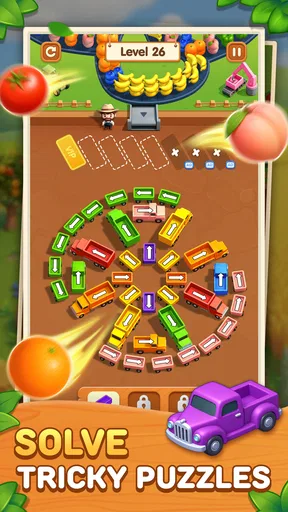
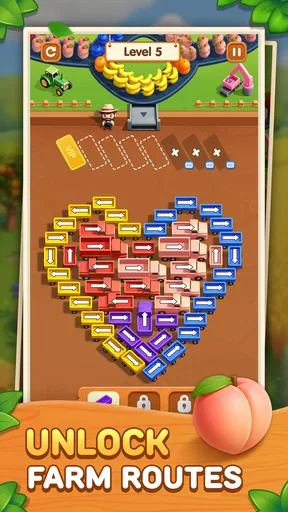
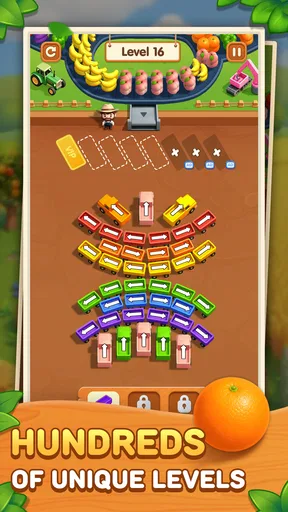
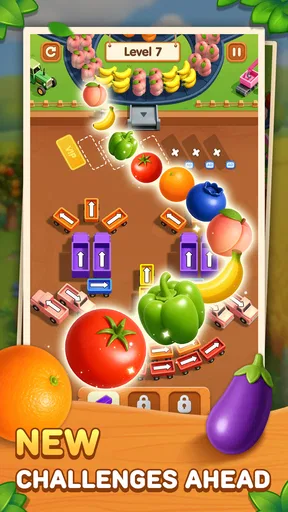
 Analysis by AppCompare
I approached Farm Madness: Traffic Jam expecting a light farm-themed puzzle game, but its appeal is less about building a large farm and more about switching between several compact logic challenges. The game combines color matching, truck sliding, car parking, and escape-style puzzles, so each activity asks for a slightly different kind of attention. That variety makes it easy to play in short bursts, although it also means the experience may feel less focused than a game built around one puzzle format.
It is a free casual game from Runyou, rated for Everyone and available for devices running Android 7.0 or later. The current version is 1.1.3, and its average rating sits at 4.5 from around 850 ratings. Those figures suggest that the basic idea has found an audience, but I would still treat it as a relaxed time-filler rather than a deep strategy game. The most useful question is whether you enjoy changing puzzle rules from one moment to the next.
What playing it actually feels like
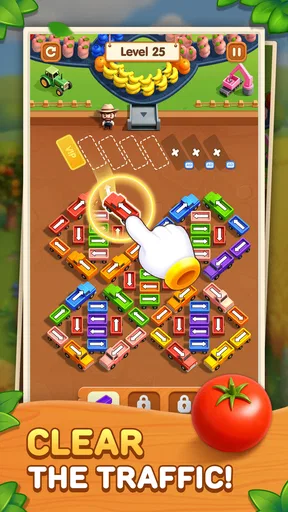
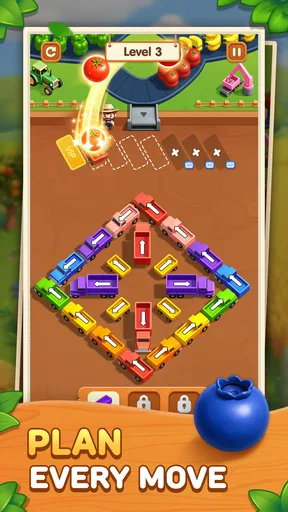
The strongest part of the design is the mixture of puzzle styles. A color-matching task rewards quick visual grouping, while a truck-sliding puzzle is more about planning space and order. Car-parking challenges can punish a careless first move, and escape puzzles usually encourage you to examine the whole arrangement before touching anything. I liked this rotation because it stopped the game from becoming completely repetitive during short sessions.
At the same time, the variety creates a small learning cost. When I moved from one type of challenge to another, I had to reset my approach instead of relying on the same habit. That is not a flaw for players who enjoy variety, but it can be frustrating if you want a smooth sequence of increasingly difficult levels with one consistent rule set. Someone who prefers a dedicated match-three game or a pure parking puzzler may find this collection less satisfying.
The farm theme gives the presentation a friendly frame, but the real identity of the game comes from the traffic and movement puzzles. I would not choose it because I wanted a detailed farming simulation. There is no reason to approach it like a management game where crops, resources, or long-term expansion are the main attraction. I found it more useful to think of the farm setting as a cheerful backdrop for small logic problems.
Where players are most likely to get stuck
The first common sticking point is treating every challenge as if it were a speed test. In the matching sections, quick recognition may help, but in truck, car, and escape puzzles, the opening move often affects everything that follows. I got better results when I paused to identify blocked routes, available spaces, and the pieces that could move without creating a new obstruction.
A second source of friction is switching from visual instinct to forward planning. A move can look productive because it clears one vehicle or creates a match, yet it may remove the only useful space for the next action. My practical rule is to look for the move that increases future options, not merely the move that produces the most obvious immediate change.
Worth Reading Before You Choose

EA SPORTS FC Mobile 26 Is a Bigger Football Game, but It Takes Time

Flipboard Shows What News Apps Must Do Beyond the Feed

Switching to Android Auto Means Rethinking Your Driving Routine

Google Calendar Makes a Crowded Week Easier to Manage

Ludo King Makes the Most of the Minutes Between Plans

Baby Panda World Brings Quick Play to Modern Phones, but Its Game Library Feels Busy
For parking-style puzzles, I recommend checking the destination and the exit route before moving the first car. If a vehicle is positioned behind another, moving the front one may be necessary, but it is not always wise to send it into the first open area you see. Leaving a vehicle in a central lane can turn a temporary solution into a permanent blockage.
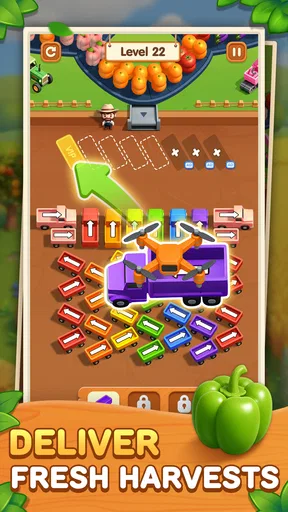
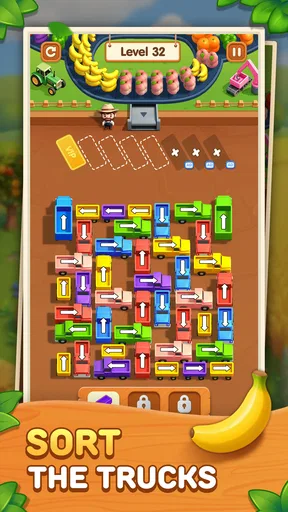
Truck-sliding puzzles deserve a similar approach. I found it helpful to identify which truck is genuinely blocking progress and which one is simply visible near the center. Moving a large piece too early can reduce the room needed for a later maneuver. If a level suddenly feels impossible, restarting mentally before restarting physically can help: trace the intended order of movement rather than repeating the same sequence faster.
Escape puzzles can be deceptive because the most noticeable object is not always the key to progress. I learned to scan corners, narrow passages, and spaces that only become useful after another object moves. This is one of the more satisfying aspects of the game, but it is also where impatient play creates the most unnecessary retries.
Checks that make the first session smoother
Because this is a free game, I would begin with a simple setup check rather than assuming every problem comes from the puzzle itself. Make sure the device meets the Android 7.0 minimum, close demanding apps running in the background, and reopen the game if the screen behaves strangely. These are ordinary steps, but they matter more in a casual title because a player may mistake a brief loading or input issue for a failed level.
I also suggest giving the game a quiet first session. Puzzle instructions are easier to understand when notifications and other interruptions are not competing for attention. This is especially useful when the game changes from color recognition to vehicle movement, since the correct response depends on noticing the layout rather than tapping quickly.
If a touch does not seem to register, I would first try the same action again with a slower, more deliberate gesture. On a crowded puzzle board, a rushed swipe can begin in the wrong place or target a neighboring object. Rotating the device or changing display settings is not something I would do automatically; I would only consider basic display adjustments if the board is genuinely difficult to read.
For a fresh installation, I would allow the opening sequence to finish before repeatedly tapping the screen. If progress appears to pause, waiting briefly and then restarting the app is a safer first response than immediately removing it. Reinstalling should be a later step, because it can erase local progress depending on how the game handles saved data. I would not clear storage casually for the same reason.
The game is suitable for Everyone, which makes it a reasonable choice for shared casual play, but the age rating does not tell me whether every puzzle will suit every attention span. Younger players may enjoy the colors and vehicles, while adults may appreciate the short logic exercises. If a child becomes frustrated, I would encourage them to describe the blockage aloud instead of taking over the controls. That turns the puzzle into a small reasoning exercise rather than a trial-and-error contest.
How I recover after a bad sequence
When I made a poor opening move, my first instinct was to keep trying to repair the board. That worked occasionally, but it was usually less efficient than stepping back and identifying the point where the available space disappeared. In traffic puzzles, one misplaced vehicle can affect every later move, so recovery is often about recognizing when the current position has become structurally weak.
A useful workflow is to separate the board into three questions: what is trapped, what can move now, and where each object needs to end up. I would answer those questions before touching anything after a failed attempt. This prevents the common mistake of moving a piece simply because it is movable. A legal move is not automatically a helpful move.
Color-matching stages benefit from a different recovery method. Instead of staring at the whole board, I would identify the clearest group or the area with the fewest alternatives. That reduces visual overload and makes the next result easier to predict. If the board becomes messy, I would stop chasing every possible match and look for the arrangement that preserves room for future combinations.
For car parking, I found it useful to reserve open space mentally. An empty lane is not just unused room; it is a resource needed to turn, pass, or reposition another vehicle. Spending all of that space on an early move can make the rest of the puzzle feel locked. This is a subtle trade-off that the short store summary does not reveal, and it is one of the main differences between casual tapping and deliberate solving.
In escape challenges, I would retrace the sequence from the first irreversible action. If a door, route, or central passage became inaccessible, the mistake probably happened before the moment when the blockage became visible. Restarting from that earlier decision is more productive than experimenting randomly with the final few moves.
Everyday uses and the right kind of player
I can see myself opening this game while waiting for an appointment, taking a short break between tasks, or winding down before bed. Its casual format suits moments when I want something interactive but do not have the time or concentration for a long story, competitive match, or complicated strategy session. The changing puzzle types also help when one format stops feeling enjoyable: I can approach the next challenge with a different mindset.
It is particularly suitable for players who like small logic problems but do not want a single mechanic repeated for a long time. If you enjoy spotting patterns, planning vehicle movement, and finding routes through crowded spaces, the combination should keep the experience reasonably fresh. The game also works for people who prefer progress through individual challenges rather than maintaining a large world or managing a long list of resources.
I would be more cautious recommending it to someone who wants a serious farming game. The farm label may suggest planting, production chains, or expansion, but the actual attraction is the puzzle mix. Likewise, players looking for competitive rankings, rich storytelling, or demanding long-form strategy should probably choose a different category. This is a game for brief mental engagement, not a substitute for a full simulation or a deep puzzle campaign.
Compared with a standard match-three title, this game asks for more spatial planning and less reliance on repeated matching. Compared with a dedicated parking puzzle, it offers more variety but may not provide the same sustained depth in vehicle positioning. Compared with an escape game, it is likely to feel more approachable because the challenges are framed alongside simpler color and traffic tasks. That balance is its main selling point, but also its main limitation: no individual mode necessarily has to carry the entire experience.
When the app is not the cause of the problem
Not every frustrating session means the level is broken. A puzzle can feel unresponsive when the intended gesture is too quick, when an object is partially covered by another, or when the player expects a move to work in a direction the layout does not allow. I would test a slow, single action before deciding that the game has failed.
If the game closes or becomes unstable, I would distinguish between a one-time interruption and a repeatable pattern. Reopening it is a sensible first step. If the same issue returns, checking available device storage, closing other apps, and ensuring the operating system is compatible are reasonable general checks. I would avoid downloading unofficial modified versions, since they can introduce problems unrelated to the original game and make troubleshooting harder.
Network conditions can also confuse the situation when an app is starting or loading content, but I would not assume that every puzzle requires a constant connection. Instead, I would observe the exact point at which the problem occurs and use ordinary restart and device checks before drawing conclusions. The important thing is not to delete local data as a first reaction, particularly if progress matters.
There is another human cause worth mentioning: fatigue. I made more poor decisions when I played several traffic layouts without a break, especially after repeatedly trying to rescue a bad position. A short pause often improved my next attempt more than another rapid restart. Since the game is designed for casual play, treating it as a series of small sessions is more comfortable than forcing a long marathon.
What version and cost mean in practice
The game is free to download, which lowers the barrier to trying its unusual combination of puzzles. I would still approach any free mobile game with normal awareness about interruptions or optional extras, but I would not let that assumption define the review. The important practical advantage is that you can test whether the mix of matching, sliding, parking, and escape puzzles suits you without committing to a paid purchase.
The current version, 1.1.3, is the one I would use when troubleshooting because version differences can change how a level or input behaves. If a friend reports that a puzzle feels different, I would first compare versions before assuming that one of us is misunderstanding the solution. Keeping the installation current is sensible, but I would also avoid updating in the middle of a session if I am trying to diagnose a temporary issue.
Runyou has kept the concept compact rather than turning it into a broad simulation. That focus helps the game start quickly in the role it is best at: a colorful collection of small challenges. It also means expectations matter. I would recommend it as a casual puzzle sampler, not as a game that replaces a specialized title in every mode.
My practical verdict after playing
Farm Madness: Traffic Jam is best when you want variety in a short, low-pressure puzzle session. I enjoyed the way a color decision could be followed by a vehicle arrangement that required a completely different kind of thinking. The farm presentation keeps the tone approachable, while the traffic and escape elements provide enough friction to make careful planning worthwhile.
Its weaknesses are equally clear. The mixed format may feel uneven to players who want one polished mechanic, and a careless early move can make some boards feel more frustrating than relaxing. The game also is not the right choice for anyone expecting a substantial farming simulation, competitive depth, or a story-driven adventure. Those players would be better served by a specialized alternative.
For everyone else, I would try it with a deliberate approach: pause before the first truck or car movement, preserve open spaces, and restart thoughtfully when a sequence has clearly collapsed. Use it in short sessions, keep basic device checks in mind if it behaves oddly, and do not confuse a difficult layout with a technical failure. With those expectations, this free casual game becomes an easy recommendation for players who want a friendly puzzle break with more variety than a standard matching app.
Its audience is already sizeable, with over 50 thousand installs, and the 4.5 average indicates that the central idea works for many players. I would not treat that number as a guarantee, because the experience depends heavily on whether you enjoy switching rules. My final recommendation is simple: choose it if the thought of moving between matching, sliding, parking, and escape problems sounds refreshing; skip it if you would rather master one puzzle system from beginning to end.
Pros
- Simple controls make it easy to start playing immediately.
- Short levels are convenient for quick gaming sessions.
- Colorful farm-themed visuals are appealing to casual players.
- Increasing traffic complexity keeps later stages challenging.
- Works well for players who enjoy puzzle and time-management gameplay.
Cons
- Some levels may feel repetitive after extended play.
- Mistakes can become frustrating when traffic patterns get crowded.
- Progress may feel slow without replaying earlier stages.
- The gameplay offers limited variety beyond managing farm traffic.
- Small visual details can be difficult to follow on smaller screens.
FAQs for Farm Madness: Traffic Jam
What is Farm Madness: Traffic Jam about?
Farm Madness: Traffic Jam is a casual puzzle game centered on managing a chaotic farmyard full of animals, vehicles, and blocked paths. Your main task is to organize movement, clear traffic jams, and guide the right animals or vehicles to their destinations. The gameplay is easy to understand, but later stages require careful planning, quick decisions, and attention to the order in which obstacles are removed.
Is Farm Madness: Traffic Jam free to download and play?
The game can generally be downloaded for free, allowing you to try its core puzzles without paying upfront. However, free versions of this type of game may include optional in-app purchases, advertising, or limited resources that encourage additional spending. Before downloading, check the store listing for the current pricing details, available purchases, and whether advertisements can be removed.
Can I play Farm Madness: Traffic Jam offline?
Many of the basic traffic-jam puzzles can usually be played without a constant internet connection, which makes the game suitable for short sessions while traveling or when mobile data is unavailable. Nevertheless, an internet connection may still be required for advertisements, cloud saving, updates, events, or purchases. It is worth launching the game online first and testing offline access on your device.
Is Farm Madness: Traffic Jam suitable for children?
Farm Madness: Traffic Jam uses colorful graphics, simple controls, and a playful farm theme, making it approachable for younger players and families. The puzzles are generally non-violent and focus on logic and coordination. Parents should still review the age rating and privacy information, particularly if children use the device, because advertisements, optional purchases, or links to external content may be included.
What devices are required to run Farm Madness: Traffic Jam smoothly?
Farm Madness: Traffic Jam is designed as a lightweight casual game and should work on many relatively recent Android and iOS phones or tablets. Performance can vary depending on the operating system version, available storage, memory, and background applications. For the best experience, install the latest official version from the appropriate app store, keep sufficient free space available, and update your device when possible.


